PaperGuru 博客
所有文章 →Sharper Papers, Lighter Credits — and Experimental Word Document Support
A broad release focused on two things researchers feel every day: the quality of what PaperGuru writes, and how many credits it takes to get there. Better citations, cleaner figures, more reliable compiles, and large credit savings on long sessions — plus an early look at generating and previewing Word documents.
作者 PaperGuru Team · 2026年6月1日

PaperGuru ships continuously, and most of those releases are small and invisible. Every so often, though, a cluster of work lands together that meaningfully changes the day-to-day experience. This is one of those moments.
This release is about two things researchers feel on every project: the quality of what the agent produces, and how many credits it takes to produce it. We went deep on both — tightening citations and references, fixing the figures and preview glitches that quietly eroded trust in the output, making LaTeX compiles far more reliable, and reworking the cost mechanics so long paper-writing sessions cost dramatically less without changing a word of what gets written.
And alongside all of that, we are opening an early, experimental door to a format many of you have asked for: Word (.docx) generation and preview.
Here are the highlights.
Better, More Trustworthy References
References are where small errors do the most damage. A fabricated author, a wrong year, an inconsistent format — any one of them can undermine an otherwise strong paper. We closed several structural gaps that made these errors possible in the first place.
-
No more invented citations. Every reference the agent produces is now drawn from real, verified records — full author lists (no silent truncation), correct venue, volume, issue, pages, DOI, and year. The agent copies verbatim bibliographic entries from authoritative sources instead of reconstructing them from memory, and a mandatory verification pass checks every field against CrossRef and OpenAlex before a paper is considered done.
-
Citing the newest work, not just the most-cited. In fast-moving fields, the agent used to anchor on canonical older papers simply because they had the most citations. Literature search now ranks results newest-first and actively pulls recent preprints into the candidate pool, so baselines and related work reflect the current state of the art rather than what was popular five years ago.
Figures and Documents That Render Correctly
A paper that reads well but renders badly still feels broken. Several fixes here target exactly that gap between what the agent writes and what you see.
-
No more overlapping or drifting figures. We fixed a preview rendering bug that could layer two images on top of each other, and tightened how the agent places figures in LaTeX so they stay in their own section instead of floating pages away.
-
Cleaner diagrams and faster image generation. Generated figures now respect the aspect ratio you asked for, large images no longer stall the session, and diagram quality rules produce clearer, properly labeled visuals.
LaTeX Compiles That Just Work
LaTeX is powerful and famously fragile. A surprising amount of friction — and credit cost — came from compiles that failed or rendered incorrectly for entirely mechanical reasons.
-
Citations no longer show up as
[?]. We fixed multiple root causes behind empty reference lists and broken in-text citations, including stale build artifacts poisoning later compiles and missing bibliography styles being silently substituted for a working equivalent. Complex multi-file projects, mixed citation styles, and concurrent compiles all now produce complete, correctly numbered references. -
More compiles succeed without a credit-charged repair loop. Compilation itself is free; what used to cost credits was the agent reading an error log and rewriting LaTeX to fix it. We added deterministic pre-compile prevention and post-failure repair for the most common, mechanical failure classes — so many builds now succeed (or self-heal) before they ever reach an expensive model-driven fix.
-
A cleaner workspace. Build intermediates and formatter backup files no longer pile up in your project or leak into the agent's context, which keeps listings tidy and avoids paying to re-read clutter.
Significant Credit Savings on Long Sessions
Paper writing is a long conversation — often hundreds of agent steps across literature review, drafting, and revision. The cost of those sessions is dominated by how context is cached and compacted behind the scenes, and we found real money being left on the table.
-
Context caching that actually saves. A core caching optimization was effectively inactive for the default model, which meant long sessions were re-paying full price for history the model had already seen. With that fixed, each step now reads the accumulated context back at a fraction of the cost. On a representative paper task, we measured an identical-output run drop by roughly 39% in credits.
-
Compaction got ~250× cheaper. When a session grows long enough to summarize its own history, that summary used to run on the most expensive model — around 800 credits per compaction. It now runs on a small, fast model suited to the job and triggers less often, bringing the cost down to roughly 3 credits with no impact on the paper itself, which is always written by the primary model.
These changes also make the Compression Levels (Normal / Balanced / Aggressive) we shipped earlier work as intended — the savings the tiers promised now genuinely materialize.
A More Reliable Workspace
- Chat history that never looks lost. A long single-turn session could render a blank chat area even though nothing was actually lost. The timeline now loads enough history to always anchor and display the full conversation.
Experimental: Word (.docx) Generation and Preview
Not every field lives in LaTeX. Many disciplines, journals, and collaborators expect a Word document — and until now, PaperGuru's output was firmly PDF-and-LaTeX shaped. With this release we are shipping an early, experimental capability to generate and preview .docx documents directly in the workspace.
This is a first step, aimed at the wide range of academic work that requires Word as the deliverable format. The agent can produce a Word document and you can preview it in the editor, without leaving your research session.
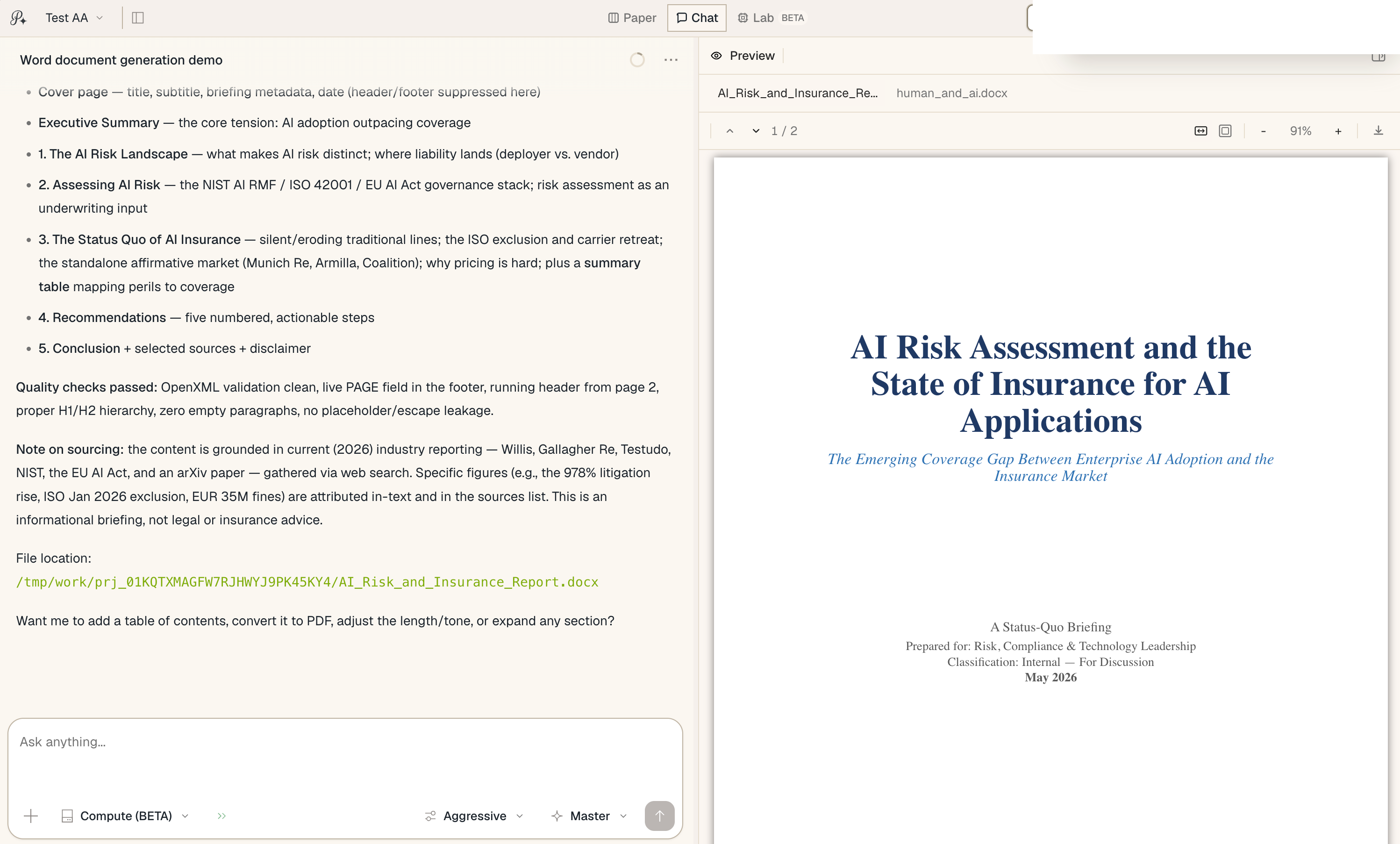
As an experimental feature, expect rough edges around formatting fidelity and complex elements — we are shipping it early precisely so we can shape it around how researchers actually use it. Your feedback here will directly steer where it goes next.
Taken together, this release should make papers come out more polished on the first try, make the parts that render look the way they should, and make long sessions noticeably cheaper — all while opening the door to a whole new output format.
As always, if something feels off — a citation that looks wrong, a figure that misbehaves, or a Word document that doesn't hold up — use the Feedback button in the top-right of the app and tell us. That feedback is what shapes the next release.
Happy researching.